Tampilkan postingan dengan label Air Services Agreement. Tampilkan semua postingan

New Zealand Agrees Fifth Freedom via Australia

7 March 2014
[Updated]
New Zealand agreed on Thursday the expansion of flight frequencies to 21 per week from the present three as well as fifth freedom traffic rights going to and from Australia to the Philippines paving the way for the long anticipated flight of Philippine Airlines (PAL) to Auckland. 

The parties also agreed on third country code sharing for seamless services between the two countries, via cooperative agreements with third country airlines.

The Memorandum of Understanding was signed between Undersecretary of Transport and Communications Jose Perpetuo M. Lotilla from the Philippines and  Principal Adviser of the Ministry of Transport Sonya van de Geer from New Zealand on March 6 at the Ministry of Transport in Wellington.

The Philippines delegation was led by Undersecretary of Transport and Communications Jose Perpetuo M. Lotilla with Philippine Ambassador to New Zealand Virginia H. Benavidez, Executive Director of the Civil Aeronautics Board Carmelo Arcilla and officials from the Department of Tourism, Department of Foreign Affairs and Civil Aviation Board as members and representatives from Philippine Airlines as observers.

The New Zealand delegation was headed by Principal Adviser of the Ministry of Transport Sonya van de Geer with officials from the Ministry of Transport and Ministry of Foreign Affairs and Trade as members and representatives from Air New Zealand, New Zealand Airports Association and Tourism Industry Association of New Zealand as observers.
With the arrangement, PAL can form code share agreements with Qantas, Air New Zealand and vice versa, with PAL as the operating carrier.

The Philippine Flag Carrier requested the Philippine Government to initiate talks with New Zealand after the government of Australia agreed for fifth freedom traffic rights from Sydney, Melbourne, Brisbane or Darwin if the third country agrees to open its doors.

For the Philippine side, it granted New Zealand equivalent fifth freedom traffic rights on any point to China.

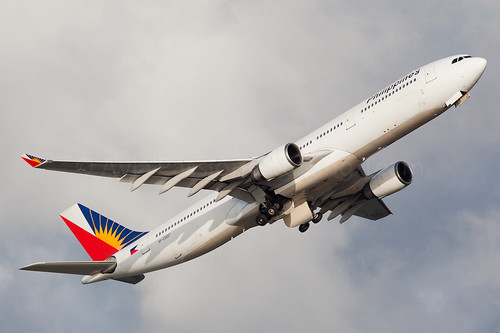
Carmelo Arcilla, Civil Aeronautics Board (CAB) Executive Director said PAL intends to fly to Auckland next year with new generation A330-300 aircraft either via Brisbane, Melbourne or Sydney.
Philippines Amends ASA with Singapore

Grants Singapore Fifth Freedom Rights To China

8 February 2014

The Philippines and Singapore agreed to allow increase in the number of seats on flights between Manila and Singapore, as well as expands fifth freedom rights between the two countries.

The new agreement increases the number of seats to around 16,800 on the Manila-Singapore route per week for each country. The current number of seats is 13,800 per week for each country.
According to Civil Aeronautics Board executive director Carmelo Arcilla, the agreement also expanded the fifth freedom rights of both countries, by adding China for Singapore upon the requests of low cost carrier Tiger Airways and Jetstar, and India for the Philippines as PAL would like to re-introduce India via Singapore. 

Fifth freedom rights refer to the airline's right to fly passengers to a third country from a country with which an airline's resident country has an outstanding air services agreement.

France Agrees Daily Flight To Paris

16 January 2014


France has agreed to grant the Philippines with seven weekly flights between Manila and Paris.

Civil Aeronautics Board Executive Director Carmelo Arcilla said the Philippines requested 14 frequencies from the French authorities but Paris granted only seven for now, an increase from the previous four it allowed in 1969.Philippine Airlines (PAL) cancelled the route in 1998 due to the Asian financial crisis while Air France cancelled the route in 2001.

Arcilla who represented Manila in the three-day talks in Paris disclosed that France agreed on third-country code sharing for Air France and KLM on the Paris-Manila route via Amsterdam.

The code share agreement means that Air France can operate from Paris to Manila via Amsterdam, using KLM as operating carrier while Philippine Airlines is the operating carrier from Manila.

The talks with France gives the AirFrance- KLM group 14 frequencies to Manila but without Air France coming over. KLM currently operates to Manila via Taipei.

PAL will enter mainland Europe initially with seven flights alternating between Amsterdam and Paris weekly this summer. The airline has operated direct flights to London since November last year. It plans to launch flight to Frankfurt and Rome also this year.

Israel Agrees 5th Freedom

Opens Rome and Madrid to the Philippines


9 November 2013

The Philippine concluded Thursday amendments to its six decades old agreement with Israel in Jerusalem with the Israeli government agreeing to provide fifth freedom rights to the Philippines going to Madrid, Spain.

Civil Aeronautics Board (CAB) executive director Carmelo Arcilla said the new agreement was signed by Undersecretary Jose Perpetuo Lotilla from the Department of Transportation and Communication (DOTC) and Giora Romm, Director of Israel’s Civil Aviation Authority.

“Under the new agreement, the designated airlines of each country are entitled to a total of 21 flights per week between any points in the Philippines and Israel," says Arcilla.


The original air service agreement with Israel was signed in 1951 providing one frequency per week and was operated by Philippine Airlines until the 1960s via Bangkok, Mumbai, and Tehran.

The new Air Services Agreement calls for three fifth-freedom flights per week on one intermediate point in Mumbai and one beyond point in Madrid.

This means that PAL can fly to India, unload and pick up passengers and proceed to Israel, or unload and pick up in Israel and proceed to Madrid.

"The agreement also calls on co-terminal and stopover rights to any third country for the 21 flights," Arcilla said.

"This means that a Philippine carrier can bring passengers to Tel Aviv and proceed to say, Rome. Or bring passengers to Tel Aviv, and pick them up again after several days for onward travel to say, Rome," he added.

The agreement is mostly tailored to Holy Land pilgrimage as the Philippines is the only Catholic nation in the far east Asia and most tour operators put Rome and Jerusalem as part of the christian journey.

Arcilla said the agreement with Israel is the fourth this year, after the Philippines signed earlier deals with Italy, Japan and Brazil. The fifth talk is between Russia scheduled next week.


PAL Arrives London

Ducks Russian Airspace

4 November 2013
image courtesy of Catherine Leech
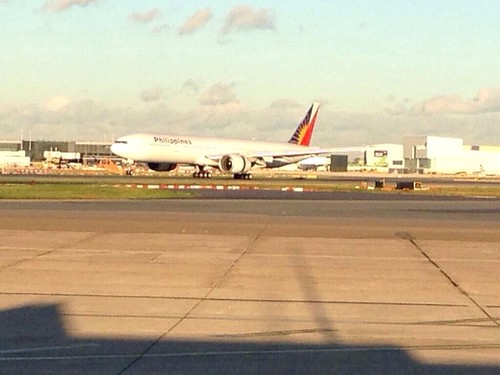
Philippine Airlines is officially back in Europe after 15 years of absence as it flies into London’s Heathrow Airport yesterday as PAL flight PR-720 using its latest Boeing 777-300ER acquisition.

The plane left Manila a little bit late at 7:55 for an unusual 15-hour flight instead of the usual 12 hours, but arrives at Heathrow at 2:50 pm London time (10:50pm –Manila) on schedule.

Beneath the celebration however is the flight plan gone wrong brought by government inefficiency on the part of the Russians causing PAL to rethink about opening Paris and Amsterdam at a much later date than what the airline hoped for this winter year as it re-scheduled inaugural plans to the summer of 2014.

PAL President Ramon S. Ang said at the inaugural flight has to leave Manila early because of the overflight dilemma over Russian airspace.

Also in the pipeline for 2014 are massive Europe invasion as it begins flights to Frankfurt, Rome, Madrid, Moscow and Istanbul. All the flights uses Russian Airspace heading towards Manila.

The Government of the Philippines was set to sit down with Russian counterparts supposedly second week of October to discuss amendments to Soviet era Air Services Agreements and overflight rights, which has on its clause payment of exorbitant Russian overflight fees over its airspace.

"We haven't secured the permit yet because they still have to meet" says Ang referring to the air talks with Russia.

The air talks was re-scheduled to the second week of November but the re-launch of PAL to London remained on schedule as it did fly its first revenue flight to Europe.

The Philippines has no Air Services Agreements with Commonwealth of Independent States countries like Turkmenistan and Azerbaijan which comprises the former Soviet Union, as these territories were part of USSR in the previous agreements. 

PAL opted to fly the longer route via Bangkok, Dubai and Istanbul airspace which is cheaper but longer against Russian overflights which is faster but has expensive fees.

The dilemma is compounded by the slots London Heathrow has allocated PAL which means that it has to arrive and depart on those windows of allowed time for full airport services or stay at the remote stand for servicing and guaranteed delays.

Arriving at London Heathrow also requires departure from Manila on time. 

The Russian Agreements will pave the way for shorter flight time to Europe. The proposed agreement would cut down the 15 hour flight to London to just 12 hour saving precious fuel and flight time. 

That also means Manila departure to around nine in the morning as the million US dollar slot allocations to Heathrow airport remain fixed, while PAL has the luxury to juggle its flights at Ninoy Aquino airport.


PAL Bags All Haneda Slots

21 October 2013


The Civil Aeronautics Board (CAB) has awarded Philippine Airlines (PAL) 14 slots out of Tokyo's Haneda Airport, citing premium services offered by the airline. It will join Japan's Air Nippon Airways (ANA )in servicing the route next summer.

CAB Executive Director Carmelo Arcilla said that Haneda is a premium airport which primarily caters to "corporate and business travel" as distinguished from leisure travel offered by other airport applicants.

Japan regulators aim is to keep Narita as the general international gateway to Tokyo while Haneda airport as Tokyo's business hub. 

Cebu Pacific and PAL Express made separate applications to fly Haneda but was rejected by CAB for being low cost airlines which doesn’t offer business class services.

Earlier, Cebu Pacific applied allocations for seven flights per week, while PAL Express applied for the entire 14 flights.

Arcilla disclosed that Haneda Airport was “clearly indicated” by their Japanese counterpart as "premium airport" intended to cater for corporate and business travelers as compared to Narita Airport which is generally open for leisure flights.

Meanwhile, CAB has approved other applications of Philippine carriers to Japan as follows:

PAL

  • Manila to Narita vice versa (14 flights per week)
PAL Express
  • Manila to Narita vice versa (14 flights per week
  • Cebu to Narita vice versa (7  flights per week)
Cebu Pacific
  • Manila to Narita vice versa (14 flights per week)
  • Manila to Nagoya vice versa (3 flights per week)
  • Manila to Fukuoka vice versa (7 flights per week)
  • Cebu to Narita vice versa (7 flights per week)
  • Cebu to Kansai vice versa (7 flights per week)
  • Cebu to Nagoya vice versa (7 flights per week)
  • Manila to Hiroshima vice versa (7 flights per week)
  • Manila to Sapporo vice versa (7 flights per week)
  • Manla to Okinawa vice versa (7 flights per week) 
  •  Manila to Ibaraki vice versa (7 flights per week )
Zest Airways
  • Manila to Narita vice versa (7 flights per week )
  • Manila to Osaka vice versa (7 fligts per week)
  • Manila to Nagoya vice versa (7 flights per week)
  • Kalibo to Nagoya vice versa (3 flights per week)
  • Kalibo to Osaka vice versa (4 flights per week )
  • Cebu to Osaka vice versa (4 flights per week )
Tigerair Philippines
  • Manila to Narita vice versa (14 flights per week)
  • Manila to Oosaka vice versa (7 flights per week)
  • Clark to Narita vice versa (7 flights per week)
  • Clark to Osaka vice versa (7 flights per week)
  • Cebu to Narita vice versa (14 flights per week)
  • Kalibo to Narita vice versa (7 flights per week)
Air Asia Philippines
  • Manila to Narita vice versa (7 flights per week)
  • Manila to Osaka vice versa (7 flights per week)
  • Manila to Nagoya vice versa (7 flights per week)
  • Kalibo to Nagoya vice versa (3 flights per week )
  • Kalibo to Osaka vice versa (4 flights per week)
  • Cebu to Osaka vice versa (4 flights per week)
The new services will be over and above existing traffic rights between the Philippines and Japan. 

Currently, PAL enjoys daily flights to Narita, Nagoya, Osaka, Fukuoka while Cebu Pacific has daily entitlements to Osaka.

Philippines to Japan weekly one-way frequencies by carrier: 
30-Sep-2013 to 20-Oct-2013

PAL controls 43 percent of total seat capacity in the Philippine-Japan market  with 31 weekly flights to Japan while Cebu Pacific has 3 weekly flights to Osaka generating less than three percent.

Japan international seat capacity by country: 7-Oct-2013 to 20-Oct-2013

PH to hold air talks with Israel, Russia next month

13 September 2013

By Lenie Lectura 


The Philippine Air panel will hold air talks with Israel and Russia next month, officials from the Civil Aeronautics Board (CAB) said on Thursday.

“The air talks in Israel are scheduled on November 4 and 5. We were the ones that initiated the discussion,” said Wyrlou Samodio, CAB legal head.

An Air Services Agreement (ASA) between the Philippines and Israel is long overdue for an amendment and the CAB official said, “We have existing bilateral agreement with Israel forged in the 1960’s or 1970’s. It’s time to amend it because there is only one frequency under that agreement.”

Samodio said Philippine Airlines (PAL) is interested to mount flights to Israel.

Also, the panel will seek to amend its ASA with Russia. “Manila will host the air talks with Russia. PAL is also interested to fly there,” added the CAB official.

The CAB forms part of the air panel, which negotiates for air entitlements with other countries.  It is an attached agency of the Department of Transportation and Communications (DOTC), mandated to regulate the economic aspect of air transportation, and shall have the general supervision, control and jurisdiction over air carriers, general sales agents, cargo sales agents and air freight forwarders.

Aside from the CAB, other members of the panel include the DOTC, Department of Foreign Affairs, Department of Tourism, Department of Trade and Industry, and representatives from airline companies.

Early this month, the Philippines successfully negotiated an amended ASA with Italy.

“We got 14 flights per week between the Philippines and Italy,” said CAB Executive Director Carmelo Arcilla. The previous agreement dated 1969 only allowed one frequency per week.

“There are 170,000 Filipinos in Italy. Rome and Milan can also be a jump-off point for traffic between Southern Europe and the Philippines,” said Arcilla.

PH Secures Daily Double Haneda Slots

PAL to fly Haneda beginning 2014


13 September 2013

The Philippines has secured double daily slots at Tokyo's Haneda airport, statement from the Civil Aviation Board disclosed.

CAB Executive Director Carmelo Arcilla said the air panel group from Japan's Department of Transport agreed to the increase in traffic rights between the two countries for total maximum flight of 400 frequencies per week from the previous 119 flights as both countries signed new Air Service Agreement (ASA).

"We also agreed on new traffic rights between Haneda Airport and Manila at 14 flights per week for each side, and unlimited traffic rights between points in the Philippines except Manila and points in Japan except Haneda," Arcilla said.

Fifth freedom traffic rights to the United States remain as previously agreed while Japan's fifth freedom traffic to Australia stays.

Philippine Airlines(PAL) manifested its intent to add capacity to Tokyo via Haneda Airport beginning summer of 2014, while Cebu Pacific plans to get a slot at Narita Airport, additional frequency to Osaka and flights to Nagoya.


PH Secures Double Daily To Italy

PR to fly Milan and Rome


6 September 2013

The Philippines has secured more landing rights to Italy after it was allowed 14 weekly frequency to the country following negotiations made on September 4 and 5.

Carmelo Arcilla, Executive Director of the Civil Aeronautics Board, said talks with Italy is long overdue since its 1969 ASA deal which allows one flight per week. Philippine Airlines last flew to Italy in 1994.

The negotiation was made possible after Philippine Airlines (PAL) requested the government for talks since they have plans to launch flights to Italy, home to more than 170,000 Filipinos, with new generations A330-300's.

“Negotiations were needed because our existing air agreement with Italy does not grant access to Milan or any Italian points outside Rome and we want to fly there,”PAL senior vice president for external affairs Socorro Gonzaga said.

Meanwhile, Gonzaga said its daily flight to Paris will have to wait until 2014 after France scheduled the talks first quarter of next year.

Philippine Airlines hopes to fly Paris in November, London by December 2013, and add Rome and Milan to their route network in the summer of 2014.

PAL Wants Return to Haneda

15 August 2013


Philippine Airlines (PAL) wants the Civil Aeronautics Board (CAB) to secure from their Japanese counterpart, the Ministry of Land, Infrastructure, Transport and Tourism (MLIT) at least a daily daytime slot pairs (6:00 a.m. to 11:00 p.m.) out of Haneda Airport says Carmelo Arcilla, CAB Executive Director.

Arcilla said that negotiations for the expansion of both countries' Air Service Agreement (ASA) is scheduled next month on September 11-13 after Japanese Prime Minister Shinzo Abe expressed satisfaction with the safety efforts initiated by the Philippines' Civil Aviation Authority (CAAP).

Arcilla added that the new bilateral aviation talks with Japan could open flights between Haneda Airport and Manila, Cebu and Davao.

PAL discloses that it wants to fly to Haneda after Japan Airlines and ANA manifested its desire to add flights to Tokyo-Haneda aside from existing Tokyo-Narita services. Haneda is the domestic hub of JAL, ANA and most of Japan's airlines and is closer to central Tokyo as compared to Narita.

Following the completion of the fourth runway in 2010, Haneda's operational capacity increased from 285,000 movements to 407,000 movements per year in contrast to Narita's two runway and night landing restrictions. This resulted to increased frequencies on existing routes, as well as bigger capacity for new routes to domestic and international destinations. Tokyo-Haneda Airport offers 60,000 additional slots for overseas flights a year at the end of March 2014 to which the Philippines would like to get at least 1,460 flights from both day and night slots.

The Philippines is eligible to get the daytime international landing slots at Haneda beginning 2014 which is currently reserved for short-haul East Asia destinations only.

Countries with daytime landing agreements to Haneda includes China, Vietnam, Thailand, Singapore, Indonesia, Germany, France and United Kingdom.

Tokyo-bound airlines, including PAL, NWA and JAL, has been using Narita airport since 1978 at the request of the Japanese Government but it can't grow flights there because the airport closes at night. Flights restrictions are currently imposed by Narita Airport between 11 p.m. and 6 a.m. due to noise concerns by Chiba Prefecture residents. 

PAL has 34 flights per week to Japan while Cebu Pacific has 11 flights per week out of the 45 weekly frequency allocations under the 2008 ASA. Japanese carriers meanwhile utilizes only 21 flight frequency (14 JAL and 7 ANA) per week to Manila.

In the 2002 ASA, there were 42 weekly frequency allocations, 21 of which was taken by Philippine Carrier while 40 flights was utilized by Japanese carriers.

CAB disclosed that it's not clear yet how many more flights will be granted by Japan considering its previous negotiation history, and the existence of 5th Freedom rights granted by the Philippines to other country's carrier. 

Arcilla is hoping that the additional flight frequencies should be substantial as the agreement between the two countries has been there for almost five years without amendments, while other countries ASA's has been re-negotiated  at least once every two years.

Carriers that enjoy fifth freedom rights include Northwest Airlines (now Delta), Egypt Air, Thai Airways and Jetstar Australia. Only Delta Airlines and Jetstar Australia regularly services the route from Manila today. 

Australia Wants Darwin Connection to Auckland

Philippines wants to connect NZ from Brisbane or Sydney

June 22, 2013

The Philippines and Australia  failed to reach consensus on new air deal this week to increase passenger traffic between them due to some “outstanding issues,” the Civil Aeronautics Board (CAB) Thursday said. 

The outstanding issue is the fifth freedom rights requested by Philippine Airlines (PAL) to New Zealand as it intends to connect Brisbane or Sydney with Auckland but Australia would like PAL to use Darwin instead.

PAL currently uses A320 aircraft to Darwin, Brisbane and Perth. If granted air rights by the Australian government, the airline would embark on Brisbane/Sydney-Auckland flights to Manila using A330.

CAB said Cebu Pacific wants for more seats to Australia but may have to forego negotiations for a “few more months” its goal of doubling the current 6,000 seat entitlements a week, which translates to about 33 flights, CAB executive director Carmelo Arcilla said. 

CAB and its Australian counterpart held talks from June 18 to June 19.

PHL-Japan Air Row Erupts

June 21, 2013

By Recto Mercene


THE Civil Aviation Authority of the Philippines (Caap) has accused Japan of not treating the country as an equal and proposed the abrogation of the air service agreement (Asa) between the two countries to President Aquino.

This came about after Japan’s Civil Aeronautics Board (CAB) refused to allow Philippine carriers such as Philippine Airlines and Cebu Pacific (CEB) to increase flight frequencies to more Japanese cities.

“They are not responsive to the Icao [International Civil Aviation Organization], which declared that all member-states are co-equal, and the impositions being made by the Japanese CAB do not indicate they are treating the Caap as a co-equal,” said Caap Deputy Director General John Andrews in an interview in his office in Pasay City.

The Icao recently gave the Caap a clean bill of health, saying the aviation body had met international standards, following a review of what it had done to address significant safety concerns during the last five years.

In 2008 the US Federal Aviation Administration (FAA) downgraded the Philippines to Category 2, meaning
Philippine carriers could no longer mount more destinations to the US, while the European Union disallowed Philippine air carriers from flying into any of its 27 member-countries.

The Icao finding paves the way for the Caap to ask the EU to remove the Philippines from the blacklist and the FAA to allow the same carriers to fly to more destinations on the US mainland.

Andrews said the EU is expected to remove the Philippines from its blacklist by the end of this month.

Despite this, however, Andrews said Japan refused to recognize the clearance that the  Icao awarded to the Philippines.

“They do not even want to have any air talks. They have made some previous requests…certain issues that we have complied with as early as two months ago and they are even demanding things that are not within their purview to ask.”

Asked to reveal what these demands are, Andrews said Japan wanted to know about the Caap’s plans and how much it was paying its employees.

“That is, I think, uncalled for, unless they feel that we should be subservient to them,” Andrews said.

He said even the President had made remarks in the past in dealing with some issues in the South China Sea that all countries must respect our sovereignty.

“We must exercise our sovereignty. We have at least gotten the respect of all major nations in the world as far as the Caap is concerned,” Andrews said.

He said a few weeks ago, Caap Director General William K. Hotchkiss, feeling insulted about Japan’s behavior, wrote President Aquino recommending the abrogation of the air treaty between the Philippines and Japan.

“The letter is now in MalacaƱang,” Andrews added.

Japan’s CAB cited that the Philippines remains on Category 2 as the reason for its refusal.

Asked if that was the reason for not allowing more Philippine carriers entry into more Japanese cities, Andrews said: “Well, they are not really stating that for a fact. But look at it this way, as soon as our low-cost airlines start going to Japan, that is going to derail the…you know what I mean.”

Asked if the reason is economic, Andrews said he does not see any other reason but economic.

PH Amends ASA with Macau

June 9, 2013

The Philippines and Macau agreed to raise seat entitlements between Manila and Macau from 3,500 to 4,500 seats per week, CAB said last week.

The agreement was in response to the request of budget carriers Zest Air and Southeast Asian Airlines for more entitlements between the two destinations.

Cebu Pacific (CEB) currently has 1253 seats per week and Philippine Airlines (PAL) has 1092 seat entitlements per week to its flights to Macau. Zest Air has been applying for a new direct flight to Macau from Manila since last year but was haunted by scheduling problems.

“The memorandum of understanding (MOU) was amended to increase the previous allowed number of seats per week,” Civil Aeronautics Board (CAB) Executive Director Carmelo L. Arcilla said.

Arcilla also said the new memorandum allowed unlimited seats between Macau and all international airports in the country, except Manila.

“In the old memorandum of understanding inked in 2007, seats between Macau and points outside Manila were limited to about 1,000.” Arcilla said.

Both countries have agreed to remove the seating limit in line with the move to increase passenger traffic to destinations outside Metro Manila under the so-called open skies policy.

“In compliance with the requirement of EO (Executive Order) 29 on open skies, the parties agreed to unlimited seats to airports outside Manila,” he said.

Seat allocation between Macau and gateways outside Metro Manila were previously limited to 10,000 under the original MOU inked in 2007.

PAL Secures 5th Freedom Rights to Brazil

As Philippines enters first Air Services Agreement to South America

May 23, 2013


The Philippines and Brazil on Wednesday signed its first Air Service Agreement with the largest South American country in a bid to boost travel between the two countries, an Official of the Civil Aeronautics Board (CAB) discloses.

CAB Executive Director Carmelo Arcilla said the Philippines, through its designated carrier Philippine Airlines got seven flight entitlements to either Sao Paolo or Rio de Janeiro with fifth freedom traffic rights to any third country points.

Brazil on the other hand also got seven flight to Manila with TAM as the designated airline with fifth freedom traffic rights to any third country points as well.

"This agreement allows for seven flights between Manila and Brazil, with fifth freedom traffic rights to any third country points. In addition it allows for unlimited traffic rights between Brazil and other gateways in the Philippines except Manila, also with fifth freedom to any third country points," Arcilla said.

Fifth freedom rights simply means the airline like PAL can land in a different country i.e. Dubai or Addis Ababa, pick up passengers and bring them to Brazil. Similarly, TAM airlines can land in Dubai or Addis Ababa pick up passengers and bring them to Manila.

PAL Secures Code-Share Deals to Dubai

Emirates Airlines commences Third daily flight

January 5, 2013
Flag carrier Philippine Airlines (PAL) and Emirates Airlines (UAE) has amended its PAL-UAE Confidential Memorandum Of Understanding (CMOU), more known as code sharing agreements, as it decides to continue the joint venture adding third daily flight between Manila and Dubai starting next week after both airlines found common terms.

The third daily flight will be staged in the morning and code-shared with Philippine airlines also using Boeing 777-300ER as equipment.

EK337 leaves Manila at 0845 arriving Dubai at 1350 while EK336 leaves Dubai at 1830 and arrives Manila 0630 the following day.

CAB executive director Carmelo Arcilla, said the deal was approved  last week paving the way for additional 7 weekly flights from both Emirates Airlines and Philippine Airlines under code-share bringing its total to 21 this year.

Previously, Abu Dhabi has 7 entitlements being used by flag carrier Etihad Airways, and Dubai has 7 entitlements used by flag carrier Emirates to Manila, while the other 14 entitlements was solely held by flag carrier Philippine Airlines (PAL). Both airlines have code-share relationship with PAL since 1998 allowing them to fly a total of 28 flights a week to Manila using Boeing 777-300ER planes.

The amended PAL-UAE Confidential Memorandum Of Understanding (CMOU) provides for a maximum entitlement of 21 weekly frequencies for UAE as the exclusive designated UAE carrier under Category 1 Route 1 to Dubai, while Category 1 Route 2 covering Abu Dhabi-Manila sector is also granted 21 weekly frequencies between PAL and Etihad Airways.

Negotiations between the two airlines almost failed after Emirates refused to code-share the third flight saying that it doesn't owned the additional frequencies granted to the Philippines. PAL owns seven frequencies to Dubai while UAE owns seven frequencies to Manila which they jointly served using Emirates Aircraft effective until 2014.

Controversy arose when the Civil Aeronautics Board (CAB) concluded new Air Service Agreement (ASA) with the United Arab Emirates providing additional 14 flights to the Emirate Kingdom. It granted additional seven rights to Dubai and seven more to Abu Dhabi for points in Manila.

CAB awarded last week the 14 new flight entitlements to United Arab Emirates (UAE) equally between Cebu Pacific and Airphil Express both of which have pending Airbus 330-300 orders. Airphil Express is a low cost subsidiary of PAL. None was awarded to Zest Air while PAL held on to 14 entitlements for Dubai and Abu Dhabi. PAL codeshared the routes to Dubai and Abu Dhabi via airline partners UAE and Etihad Airways (ETD) for a total of 28 flights between the two countries.

The grant of rights to Cebu Pacific also dissolves anti-trust concerns which PAL had with the Board requiring it to service the routes to the UAE.

Earlier, Cebu Pacific (CEB) filed a complaint against PAL for forfeiture of its rights  to fly the United Arab Emirates arising from non-use of bilateral air traffic rights. CEB wants to fly to the middle east starting winter season next year but their plans to expand to the region was hampered by lack or inadequate flight entitlements which were all taken by PAL and its codeshare partners. CAB rules that PAL was actively flying the route. Consequently, the government of the Philippines and the Arab Emirates expanded their Air Treaty to cover 28 weekly frequencies between Dubai, Abu Dhabi and Manila.

Previously, PAL in its Opposition letter to Emirates contend that the airline plans to introduce its own-operated flights to the United Arab Emirates by 2012 and 2014, “given the assurance that no more than 28 weekly frequencies are to be operated by each side on the agreed routes between the UAE and Manila.”

PAL codeshared the routes to Dubai and Abu Dhabi via partners Emirates and Etihad Airways (ETD) for a total of 28 flights between the two countries.

CAB Executive Director Carmelo Arcilla said Abu Dhabi has 7 entitlements being used by flag carrier Etihad and Dubai has 7 entitlements used by flag carrier Emirates to Manila, while the other 14 entitlements was solely held by flag carrier Philippine Airlines (PAL). Both airlines have code-share relationship with PAL allowing them to fly a total of 28 flights a week to Manila using Boeing 777-300ERequipments.
Older Post ►
eXTReMe Tracker
 

Copyright 2011 Philippine Aviation is proudly powered by blogger.com