Tampilkan postingan dengan label Emirates. Tampilkan semua postingan

Emirates Cancels Clark Due To Heavy Losses

Ends May 1

23 March 2014

By Daniel Shane

Dubai carrier Emirates Airline is to scrap a daily service to a key air hub in the Philippines just seven months after launching the route.

Emirates will cease its daily flights to Clark International Airport from May 1, a spokesperson confirmed, following a review of its operations.

The service to Clark International, located in the Greater Manila Area, was the only long-haul route to be operated outside of the country’s primary Ninoy Aquino International Airport in the capital.

Following the service’s launch in October last year, Emirates embarked on a highly visible marketing campaign to promote the route to the UAE’s large Filipino community.

“Emirates can confirm that it is suspending its daily, non-stop service between Clark International Airport and Dubai from 1st May 2014. The decision was made after a review of the airline’s operations to ensure the best utilisation of its aircraft fleet for its overall business objectives,” a spokesperson for Emirates told Arabian Business.

“Emirates will continue to operate its three daily, non-stop flights between Manila and Dubai and is taking all necessary steps to accommodate affected passengers on alternate flights,” they added.

Earlier this year, aviation analysts warned that airlines are losing money on the UAE-Philippines route and will soon be forced to cut flights.

The Centre for Asia Pacific Aviation (CAPA) said too many carriers had entered the once-lucrative market, with 24 flights per week added in the last quarter of 2014 alone.

Despite huge traffic between the countries – there are about 700,000 Filipinos working in the UAE, the Asian country's fourth largest overseas community – airlines including Dubai's Emirates, Abu Dhabi's Etihad and three Filipino carriers had saturated the market to the point that competition had become too great.

“While there is considerable traffic between the Philippines and UAE, yields are generally low and there are large seasonal fluctuations,” a CAPA report said.

“On a year-round basis the Philippines-UAE is not an easy market to turn a profit on, particularly without any ability to sell flights beyond the UAE.

“But December and January are peak months for the Philippines-UAE market, as Filipinos working overseas typically make their trips back home during the holiday season. February and March will be more challenging months, while April will see another peak for Easter.”

The route became overcrowded during the previous few months, with three Philippine carriers entering the market – low-cost airlines Cebu Pacific and PAL Express and flag carrier Philippine Airlines.

Etihad Airways also serves Abu Dhabi-Manila with two daily flights.

Gigie Baroa: Flying high with Emirates Philippines

By Iris C. Gonzales
As published in The Philippine Star 
on October 1, 2013

MANILA, Philippines - Maria Brigitte “Gigie” Baroa’s story as Emirates Philippines country manager started with one “strange call.”

In the story, the voice on the other line asked to meet with Baroa and later on, asked her if she would be interested in joining Emirates.

This was in 1990 or one year after Baroa became the country manager for Air India.

“A year later I got some strange call. It was from somebody I totally didn’t know,” Baroa told The Star.

“’We’re from Emirates. We’re in town and we’re seeing friends and your name came up. We’ve looked at the list of airlines operating from Manila and we’d like to learn more about Air India and we’d like to meet with you,” Baroa quoted the caller as saying.

Baroa agreed to the meeting, held at the lobby of then Philippine Plaza Hotel.

“We discussed tourism industry what kind of traffic I had at Air India. Right, then and there ‘they said, would you be interested to join us?’” Baroa said, her eyes still beaming as she recalled the fateful call.

It would be the start of a career in Emirates for Baroa.

Yet at the onset, Baroa was destined to become big in the travel and tourism industry.

Tourism, for her, was simply love at first sight.

“It’s really the joy of being out in the field more than anything else. I knew from college that I would not do a desk job. I was taking economics and I could not imagine myself in a desk in a bank. My parents wanted me to be a banker. I had to think of something else. I wanted to be really good,” Baroa said.

At the time, during her college days, tourism was a big thing.

“This was the Marcos days. I was really active in school,” she said.

Together with a college friend, Baroa put up the very first travel organization in Ateneo, the Ateneo Travel Club.

“We would put up packages for domestic runs for friends, during the holidays, she said.

She eventually moved to the Asian Institute of Tourism at the University of the Philippines, Diliman.

“Tourism was a big thing. I said oh-my-God that’s perfect for me. So I moved. I finished first tourism and then a year after, I finished my economics,” she said.

From school, one of her professors asked her to work with the Andres Soriano Group or Anscor.

“At the time, they were the big guns. They still owned San Miguel, Coke…I started with their travel unit called Tours Specialist and then they set up a travel holding company to combine, in-bound, out- bound flights, conventions, events and merchandising,” she narrated.

“I was moved to the holding company called Anscors’ Tourism Development Corp. When I moved out of the company, I was already conventions manager and then I had a short stint with an exhibition company. This gave me an international experience in handling conventions here,” she said.

Her experience made her ripe for a stint at Air India, which would later become her stepping-stone to the giant Emirates.

The rest, as they say, is history.

Yet Baroa recalls that putting up Emirates in the Philippines was quite a challenge.

 “In the past, Middle East carriers were for labor traffic only. The perception was that it was smelly or only meant for cheap labor. It was difficult during our first year,” she said.

But with enough experience, Baroa carried on and pushed to bring Emirates in the radar screen of Filipino travellers.

“I was very lucky because the sales manager I had at the time was a Filipina who could speak both English and Chinese and at the time, we only had two to three flights a week via Hong Kong and of all time slots our Manila-HK had a departure of 5:30 in the morning. My Manila HK was the worst time slot,” she said.

Baroa and her team was unfazed.

“We tried out everything from fairs to promos. We tried menu tasting. We wanted to show everybody that we were okay. We were the first Middle East carrier for leisure and not just for labor. Slowly, we had people trying out our Manila-HK flights promotions. We had our door- to-door with agents,” she said.

And because hard work always pays off, the Emirates’ Manila-HK flights became quite a hit among the Chinese market and the byahera crowd or the businessmen and women who have shops in Greenhills and would often go in and out of the country for new items.

 “Later on it became such a hit that we were able to get the Chinese Binondo market. We had traffic coming from Cebu to catch our Manila - HK flight. This was in spite of the early departure. We managed to come up with something that would attract them. You get to HK at 7 am you don’t waste time. You can maximize your stay in HK compared to our competitors at the time. That was our selling point,” she said.

Eventually, the HK station had grown full-blown that it could already operate on its own.

Now, Emirates Philippines remains true to Emirates position in the global airline industry market.

“We’re already one of the big boys. We’re no longer just the little brother,” Baroa said.

Now Emirates Philippines has 21 flights a week out of Manila, three times daily.

 “With the entry of Emirates into the market, we’d like to think that we’ve raised standards. We put in entertainment. We were the first carrier to do that. We had an inflight entertainment. We were the first one to have inflight entertainment operated from special buttons from the seat, tapping on the screen. Our price is really value for money,” she said.

Today, Emirates soars even higher with the launch of its Clark-Dubai flights on October 1.

The daily flights will aim to capture the overseas Filipino workers who hail from central and northern Luzon.

 “We hope we can grow further and expand the market. Ten years ago, we wouldn’t have thought of Clark. A study was made and our planning people said Clark is now ripe. It was a very thorough study. There’s a lot of investment but we’re pretty confident after a while, market will pick up. Passengers will realize there’s a lot of convenience in using Clark. It doesn’t make sense to go to Manila when all services are available in Clark,” she said.

Indeed, with Baroa at the helm, Emirates Philippines has nowhere to go but to fly higher.

Emirates to fly Clark

Begins Flight October 1

February 18, 2013

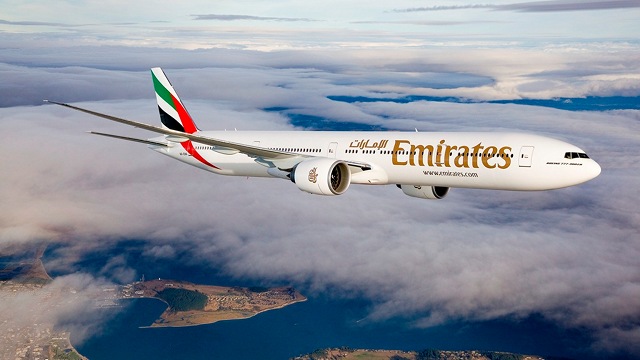
Emirates Airlines announced that it will begin daily flights between Dubai and and Manila-Clark starting October 1 2013 using Boeing 777-300ER aircraft.

Emirates flight EK338 will depart Dubai at about 4 am and arrive at Clark International Airport at 4:40 pm. The return flight, EK339 will depart at 6:35 pm and arrive at Dubai International Airport at 11:05 pm.

The airline operates 3 daily flight out of NAIA and has been operating in the country since 1990.

“The launch of flights between Clark International Airport and Dubai will offer our passengers the flexibility of choosing from two destinations in the Philippines,” said Tim Clark, President Emirates Airline in a statement on Monday, February 18.

The new route also allows Emirates SkyCargo to provide more than 160 tonnes of additional cargo hold capacity each way per week, further supporting Philippines exports of perishables, such as dairy products, fruit and vegetables, meat, seafood and electrical and electronic equipment, and its imports of textiles, apparel, plants, flowers and chemical products.

PAL Secures Code-Share Deals to Dubai

Emirates Airlines commences Third daily flight

January 5, 2013
Flag carrier Philippine Airlines (PAL) and Emirates Airlines (UAE) has amended its PAL-UAE Confidential Memorandum Of Understanding (CMOU), more known as code sharing agreements, as it decides to continue the joint venture adding third daily flight between Manila and Dubai starting next week after both airlines found common terms.

The third daily flight will be staged in the morning and code-shared with Philippine airlines also using Boeing 777-300ER as equipment.

EK337 leaves Manila at 0845 arriving Dubai at 1350 while EK336 leaves Dubai at 1830 and arrives Manila 0630 the following day.

CAB executive director Carmelo Arcilla, said the deal was approved  last week paving the way for additional 7 weekly flights from both Emirates Airlines and Philippine Airlines under code-share bringing its total to 21 this year.

Previously, Abu Dhabi has 7 entitlements being used by flag carrier Etihad Airways, and Dubai has 7 entitlements used by flag carrier Emirates to Manila, while the other 14 entitlements was solely held by flag carrier Philippine Airlines (PAL). Both airlines have code-share relationship with PAL since 1998 allowing them to fly a total of 28 flights a week to Manila using Boeing 777-300ER planes.

The amended PAL-UAE Confidential Memorandum Of Understanding (CMOU) provides for a maximum entitlement of 21 weekly frequencies for UAE as the exclusive designated UAE carrier under Category 1 Route 1 to Dubai, while Category 1 Route 2 covering Abu Dhabi-Manila sector is also granted 21 weekly frequencies between PAL and Etihad Airways.

Negotiations between the two airlines almost failed after Emirates refused to code-share the third flight saying that it doesn't owned the additional frequencies granted to the Philippines. PAL owns seven frequencies to Dubai while UAE owns seven frequencies to Manila which they jointly served using Emirates Aircraft effective until 2014.

Controversy arose when the Civil Aeronautics Board (CAB) concluded new Air Service Agreement (ASA) with the United Arab Emirates providing additional 14 flights to the Emirate Kingdom. It granted additional seven rights to Dubai and seven more to Abu Dhabi for points in Manila.

CAB awarded last week the 14 new flight entitlements to United Arab Emirates (UAE) equally between Cebu Pacific and Airphil Express both of which have pending Airbus 330-300 orders. Airphil Express is a low cost subsidiary of PAL. None was awarded to Zest Air while PAL held on to 14 entitlements for Dubai and Abu Dhabi. PAL codeshared the routes to Dubai and Abu Dhabi via airline partners UAE and Etihad Airways (ETD) for a total of 28 flights between the two countries.

The grant of rights to Cebu Pacific also dissolves anti-trust concerns which PAL had with the Board requiring it to service the routes to the UAE.

Earlier, Cebu Pacific (CEB) filed a complaint against PAL for forfeiture of its rights  to fly the United Arab Emirates arising from non-use of bilateral air traffic rights. CEB wants to fly to the middle east starting winter season next year but their plans to expand to the region was hampered by lack or inadequate flight entitlements which were all taken by PAL and its codeshare partners. CAB rules that PAL was actively flying the route. Consequently, the government of the Philippines and the Arab Emirates expanded their Air Treaty to cover 28 weekly frequencies between Dubai, Abu Dhabi and Manila.

Previously, PAL in its Opposition letter to Emirates contend that the airline plans to introduce its own-operated flights to the United Arab Emirates by 2012 and 2014, “given the assurance that no more than 28 weekly frequencies are to be operated by each side on the agreed routes between the UAE and Manila.”

PAL codeshared the routes to Dubai and Abu Dhabi via partners Emirates and Etihad Airways (ETD) for a total of 28 flights between the two countries.

CAB Executive Director Carmelo Arcilla said Abu Dhabi has 7 entitlements being used by flag carrier Etihad and Dubai has 7 entitlements used by flag carrier Emirates to Manila, while the other 14 entitlements was solely held by flag carrier Philippine Airlines (PAL). Both airlines have code-share relationship with PAL allowing them to fly a total of 28 flights a week to Manila using Boeing 777-300ERequipments.

The Not-so Secret MOU to Dubai

PAL Cries Foul Over Emirates Refusal to Code Share 3rd Flight

November 12, 2012

Flag carrier Philippine Airlines (PAL) has asked the Civil Aeronautics Board (CAB) to reject the petition of Emirates Airlines (UAE) to add third daily flight starting January 1, 2013 between Dubai and Manila stating that the additional schedule was "counterproductive and unjustified."

The reason, UAE already fly 14 times a week, the agreement with them say so. PAL cannot fly to the gulf state because of previous secret agreement with UAE set to expire in 2014.

Negotiations between the two airlines failed after Emirates refused to code-share the third flight saying that it doesn't owned the additional frequencies granted to the Philippines.

Earlier, Cebu Pacific (CEB) filed a complaint against PAL for forfeiture of its rights  to fly the United Arab Emirates arising from non-use of bilateral air traffic rights. CEB wants to fly to the middle east starting winter season next year but their plans to expand to the region was hampered by lack or inadequate flight entitlements which were all taken by PAL and its codeshare partners. CAB rules that PAL was actively flying the route. Consequently, the government of the Philippines and the Arab Emirates expanded their Air Treaty to cover 28 weekly frequencies between Dubai, Abu Dhabi and Manila.

According to PAL in its Opposition letter to Emirates Petition (CAB CASE No. EP-59079/HED102012-261) for additional third daily flight, the airline intends to introduce its own-operated flights to the United Arab Emirates by 2012 and 2014, “given the assurance that no more than 28 weekly frequencies are to be operated by each side on the agreed routes between the UAE and Manila.” 

PAL codeshared the routes to Dubai and Abu Dhabi via partners UAE and Etihad Airways (ETD) for a total of 28 flights between the two countries.

“As code share partner, PAL honors its existing code share arrangement which remains in effect until 2014. Our objection is to the proposed unjustified and counterproductive excess of seven frequencies, or for that matter any formulation that results in an EK operation in excess of 14 frequencies per week on the Dubai-Manila route,” PAL said. 

Further, PAL said that the new PAL-UAE Confidential Memorandum Of Understanding (CMOU) already provided for a maximum entitlement of 14 weekly frequencies for UAE as the exclusive designated UAE carrier under Category 1 Route 1. Category 1 Route 2 covers Abu Dhabi-Manila sector.

PAL also said that UAEs proposed petition would undermine the earlier negotiation of a new CMOU in September that was intended to usher in a new development era where the airlines of both the Philippines and the UAE would offer their own self-operated services in an environment of fair and healthy competition.

“As the board will noted, EK’s proposed 21 times weekly service will result in a total UAE carrier operation of 36 weekly frequencies when added to the existing 14 times weekly Abu Dhabi-Manila services of Etihad Airways, the UAE’s designated carrier for Category 1 Route 2 under the CMOU,” PAL said.

UAE argued however that PAL's interpretation is flawed.

Gigie V. Baroa, UAE Philippine manager explained that while both of them are entitled to fly 7 times a week for a total of 14 flights between Dubai and Manila which they are now doing, another 7 entitlements was granted by both Arab Emirates and Philippine government last September 11, expanding bilateral services between these two points.

"The United Arab Emirates awarded this additional entitlement to Emirates Airlines" says Baroa.

“It was in the fact the agreement of the aeronautical authorities of the two governments that the pre-existing borrowing of unused entitlements could continue alongside the additional daily services granted under the new confidential memorandum of understanding of Sept. 6,” Baroa said.

PAL did not get the new entitlements nor applied for the same. The seven additional frequencies are still to be divided between Cebu Pacific and Zest Air which applied to service the routes.(Air Philippines applied for this route after blog posting)

"The requested additional frequencies will not just benefit Emirates but the Philippine carriers as well" Baroa adds citing growth demands on the market.

The other 7 entitlements on the Philippines side is yet to be awarded by CAB. The applicants for the route were Zest Airways (EZD), and CEB and they were both asking for seven flights says a CAB insider.
Older Post ►
eXTReMe Tracker
 

Copyright 2011 Philippine Aviation is proudly powered by blogger.com